
Evolution of India’s EMIS.
Educational Management Information Systems in India: A History from the Colonial Era to UDISE+ and Beyond
Introduction
“Educational Management Information Systems in India: A History from the Colonial Era to UDISE+ and Beyond” is the first comprehensive history of education statistics and EMIS in India, tracing the journey from colonial quinquennial reviews and ES-Forms to DISE, UDISE and today’s UDISE+. Written by Prof. Arun C. Mehta, former Professor & Head, EMIS Department, NIEPA, it combines a historical narrative, policy analysis, and firsthand experience spanning three decades of system-building.
e-Books of Prof. Arun C Mehta
- e-Book on India’s School Education in Data: An Analysis of UDISE+ 2024–25 by Arun C Mehta [PDF]
- e-Book on Higher Education at the Crossroads AISHE 2021-22 by ArunCMehta [PDF]
- e-Book on From Kothari Commission to NEP 2020: Six Decades of Universalising School Education in India [PDF]
- Fourty Years of Arun C Mehta at NIEPA: 1980 to 2019 [PDF]
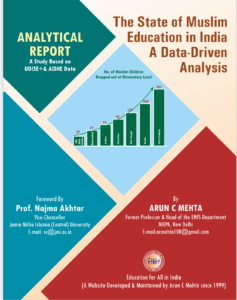
- The State of Muslim Education in India: A Data Driven Analysis by Prof. Arun C Mehta [PDF]
- e-Book on Educational Management Information Systems in India: A History from the Colonial Era to UDISE+ and Beyond
- e-Book on Educational Management Information Systems in India: A History from the Colonial Era to UDISE+ and Beyond [PDF]
Objectives
- To document 140 years of education statistics in India, from colonial reviews to SDG 4 monitoring.
- To analyse the design, performance and limitations of successive EMIS systems (ES-Forms, AISES, COPE, DISE, UDISE, UDISE+ and AISHE).
- To present a firsthand account of the development of DISE/UDISE (1994–2017) and its recognition as Official Statistics.; and
- To place India’s EMIS in an international perspective and propose ten concrete recommendations for its future.
Data and Sources
The book draws on: colonial Quinquennial Reviews, Ministry ES-Forms, NCERT’s eight All India Educational Surveys, DISE/UDISE publications, UDISE+ 2018–2025, AISHE 2011–22, Census, NSS, ASER, NAS, NFHS and key policy documents (Kothari Commission, High Level Committee 1982, NPE 1986, Dakar EFA, RTE 2009, NEP 2020, SDG 4). It includes 11 original charts (EMIS timeline, time-lag trends, DISE expansion, DCF evolution, international comparisons) and 9 statistical tables covering more than 70 years of EMIS history of India.
Major Findings
- India moved from slow, aggregate, highly delayed statistics (ES-Forms, AISES, COPE) to a robust, school-based annual census under DISE/UDISE, cutting time lag from 7–8 years to under 1 year and expanding coverage from 42 districts to 14.71 lakh schools.
- DISE/UDISE at NIEPA (2002–2017) met most of the criteria for a good EMIS: school as the unit, annual coverage, comprehensive and disaggregated data, rapid dissemination, public access, and international credibility, culminating in Official Statistics status in 2012–13.
- UDISE+ introduced major technical advances (online system, student-level SDMS, APAAR IDs, 22+ crore individual records), but at the cost of increased time lags, weaker publications, and reduced data transparency compared to the NIEPA era.
- EMIS for higher education (AISHE) has improved institution-level data but still suffers from time lags, incomplete coverage, and a lack of integration with UDISE+.
- International experience (Nepal, Ghana, Cambodia and others) shows India’s DISE/UDISE model is globally significant, yet current institutional arrangements risk eroding earlier gains in quality and dissemination.
Concluding Observations
The book concludes that DISE/UDISE under NIEPA represents one of the most successful EMIS reforms in the developing world. However, recent shifts under UDISE+ have weakened timeliness, public access and analytical output. It argues that India now needs to restore short-term lags, revive disaggregated publications, open anonymised SDMS data, link UDISE+ with AISHE and learning-outcome surveys, strengthen MIS capacity, and reconsider the institutional home of EMIS to meet SDG 4 and NEP 2020 ambitions.
References/Key Readings
The e-book is based primarily on Prof. Mehta’s own articles and reports on educationforallinindia.com (including “Educational Information System in India and its Limitations”, “Strengthening EMIS in India: A Case of UDISE”, “Rise & Fall of UDISE”, and “Reclaiming Glory: How NIEPA Can Regain its Leadership in Educational Planning”). It also cites core government and international sources, including the Kothari Commission Report, the 1982 High-Level Committee, NPE 1986 & PoA 1992, NCERT AISES reports, UDISE/UDISE+ and AISHE reports, NEP 2020, the Dakar Framework, SDG 4 documents, and UIS EMIS guidelines.

Evolution of India’s Education Data.