
Education Evolution in India 1968 to 2020.
e-Book on
From Kothari Commission to NEP 2020: Six Decades of Universalising School Education in India
A Data-Driven Historical Analysis: 1964–2025
e-Book on From Kothari Commission to NEP 2020 [PDF]
Education and National Development : Report of The Education Commission, 1964-66 (Vol. 1)
Education and National Development : Report of The Education Commission, 1964-66 (Vol. 2)
Introduction
From Kothari Commission to NEP 2020: Six Decades of Universalising School Education in India is a data-driven historical analysis of India’s school education system from 1950 to 2025, with a special focus on the six-decade arc between the Kothari Commission (1964–66) and NEP 2020. It combines policy history with long-run statistical trends drawn from DISE, UDISE, UDISE+, AISHE, Census and official Ministry of Education documents.
e-Books of Prof. Arun C Mehta
- e-Book on India’s School Education in Data: An Analysis of UDISE+ 2024–25 by Arun C Mehta [PDF]
- e-Book on Higher Education at the Crossroads AISHE 2021-22 by ArunCMehta [PDF]
- From Kothari Commission to NEP 2020: Six Decades of Universalising School Education in India [PDF]
- Fourty Years of Arun C Mehta at NIEPA: 1980 to 2019 [PDF]
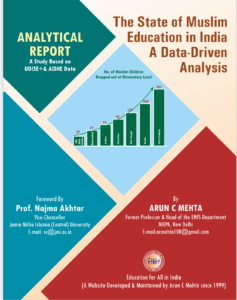
- The State of Muslim Education in India: A Data Driven Analysis by Prof. Arun C Mehta [PDF]
- Educational Management Information Systems in India: A History from the Colonial Era to UDISE+ and Beyond
- Educational Management Information Systems in India: A History from the Colonial Era to UDISE+ and Beyond [PDF]
Objectives
- To trace how India moved from the constitutional promise of free and compulsory education to NEP 2020’s comprehensive reform agenda.
- To analyse the evolution of major programmes and policies (DPEP, SSA, RTE, RMSA, Samagra Shiksha, NEP 2020) using consistent time-series
- To document, for the first time in one volume, the history and contribution of DISE/UDISE/UDISE+ as the backbone of India’s school education statistics; and
- To assess what Kothari’s vision achieved, what remained unfinished, and what NEP 2020 must deliver to complete six decades of work.

Six-Decades-of-Indian-Education.
Data and Methods
The book relies entirely on official datasets and the author’s earlier analytical reports: DISE and UDISE publications, UDISE+ 2024–25, AISHE 2021–22, Census 1951–2011, Five-Year Plans, Economic Surveys, ASER reports and core policy documents (NPE 1968/1986, RTE 2009, Samagra Shiksha, NEP 2020). It presents 12 historical charts and 10 statistical tables covering indicators such as schools, enrolment, GER, dropout rates, GPI, teacher strength, and public expenditure on education over seven decades.
Headline numbers for 2024–25 include 14.71 lakh schools, 24.69 crore students and 1.01 crore teachers, with primary dropout down to 0.3% and GPI at primary reaching 1.03. The analysis also uses disaggregated trends for SC, ST, and Muslim children, as well as inter-state comparisons such as Kerala versus Bihar.
Major Findings
- Access revolution, quality crisis:Schools increased roughly seven-fold and primary GER reached and even exceeded 100% around 2010, but learning levels remain weak; ASER 2024 shows only about one-fourth of Class 3 students can read a Class 2 text.
- Gender parity achieved, but not equity for all:GPI at all levels has reached or crossed 1.0, yet secondary and higher education gaps persist by state and social group, especially for SC/ST students in backward regions.
- The 6% of GDP promise remains unmet:From Kothari’s 1964 recommendation of 6% of GDP for education to NEP 2020’s reiteration, public spending has plateaued around 4–4.6% of GDP and never reached the target.
- Data systems transformed planning:DISE (1994–95) grew into UDISE and then UDISE+, becoming the world’s largest school education database and shifting from school aggregates to student-level tracking. However, transparency and analytical accessibility have declined in the latest phase.
- Programme evolution built on state “laboratories”:Innovations from Shiksha Karmi, Lok Jumbish, Bihar Education Project, UP Basic Education Project, APPEP and Mahila Samakhya fed directly into DPEP and SSA designs (para-teachers, VEC/SMC, EGS, CRC/BRC, women’s collectives).
- Secondary education as a late priority:RMSA and then Samagra Shiksha began addressing long-standing neglect of secondary schooling, raising secondary GER to about 78–79%, but only around 47% of children who enter Class 1 currently complete Class 12.
- Common School System remains “the road not taken”:Kothari’s proposal for a Common School System was never implemented, and India’s dual structure of government versus private schools continues to reproduce social stratification.
Concluding Observations
The book concludes that India’s school education story is one of dramatic progress in access, incomplete and uneven progress in equity, and persistent failure in learning quality. It argues that without reaching the long-promised 6% of GDP, strengthening decentralised planning capacity, and confronting structural inequality between public and private schooling, NEP 2020’s ambitions will remain unrealised. It also emphasises that SC/ST and girls’ educational gains are among the most significant social achievements of independent India and must be consolidated at the secondary and higher levels.
References and Sources
Primary Policy Documents
- Government of India. (1966). Education and National Development: Report of the Education
- Commission 1964–66 (Kothari Commission), Vols. 1 & 2—Ministry of Education, New Delhi.
- Government of India. (1968). National Policy on Education 1968. Ministry of Education, New
- Delhi.
- Government of India. (1986). National Policy on Education 1986 (revised 1992). Ministry of
- Human Resource Development, New Delhi.
- Government of India. (2001). Sarva Shiksha Abhiyan: Framework for Implementation.
- Department of Elementary Education and Literacy, MHRD, New Delhi.
- Government of India. (2009). The Right of Children to Free and Compulsory Education Act,
- 2009.
- Government of India. (2018). Samagra Shiksha: An Integrated Scheme for School Education.
- Department of School Education and Literacy, Ministry of Education, New Delhi.
- Government of India. (2020). National Education Policy 2020. Ministry of Education, New
- Delhi.
- Ministry of Education, Government of India. (2025). UDISE+ 2024–25 Report. Department of
- School Education and Literacy, New Delhi.
DISE/UDISE Publications (NIEPA, New Delhi)
- Mehta, A.C. (1995–2018). Elementary Education in India: Where Do We Stand? Annual
- DISE/UDISE Analytical Reports. NIEPA, New Delhi.
- Mehta, A.C. (Various years). DISE Flash Statistics. NIEPA, New Delhi.
- Mehta, A.C. (Various years). District and State Report Cards. NIEPA, New Delhi.
- e-Book | From Kothari Commission to NEP 2020 | Prof. Arun C. Mehta | educationforallinindia.com
Author’s Articles
All chapters are compiled and synthesised from the following articles by Prof. Arun C. Mehta, published on Education for All in India (www.educationforallinindia.com):
- From Sargent Commission to NEP 2020: A History of Indian Education Policy, August 2025
- National Policy on Education: A Comprehensive Review (January 2026)
- Universalisation of School Education in India: Progress, Challenges, and Future
Projections
- Samagra Shiksha Abhiyan: Architecture, Planning, and Data (May 2020)
- Sarva Shiksha Abhiyan: Framework, Achievements, and Limitations (January 2023)
- Status of UDISE+ and Planning under Samagra Shiksha (January 2023)
- Planning under Samagra Shiksha: School Education in India (August 2022)
- Promoting Education Expenditure to 6% of GDP in India (October 2025)
- Education Across Generations in India 1928–2025 (November 2025)
- The Three-Language Formula in India: Evolution, Implementation, and Contestation
- NEP 2020 and After That (September 2025)
- Analysis of UDISE+ 2024–25 Data (August 2025)
- Status of School Education in India: UDISE+ 2021–22 to 2024–25 (2025–26)
Other Key Sources
- Pratham Education Foundation. (2005–2024). Annual Status of Education Reports (ASER). New Delhi.
- Census of India. (1951, 1961, 1971, 1981, 1991, 2001, 2011). Office of the Registrar General and Census Commissioner, Government of India, New Delhi.
- Ministry of Finance, Government of India. (Various years). Economic Survey. New Delhi.
- Planning Commission/NITI Aayog, Government of India. (1951–2017). Five-Year Plan Documents.

भारतीय स्कूली शिक्षा का सफर 1968 to 2020